Journal
Paint or Wax Stripped Reclaimed Pine Doors: A Craftsman's Guide
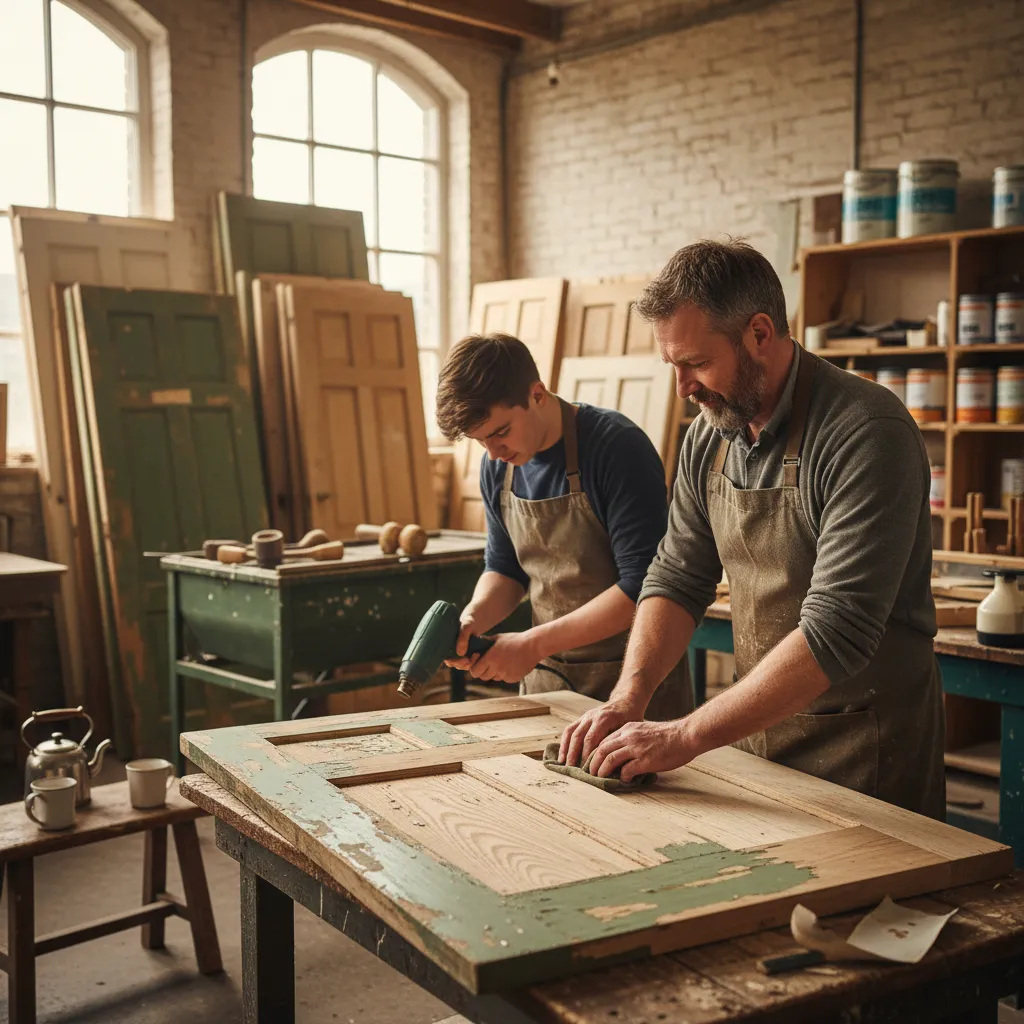
Quick answer: should you paint or wax stripped reclaimed pine doors?
Should you paint or wax stripped reclaimed pine doors? Wax wins for most of them, because it protects the timber, shows off the grain, and ages gracefully. Paint belongs on doors with deep damage, mismatched repairs, or a modern look you want to lock in.
Daniel at Double Dipper Paint Strippers in Honley sees the same trade-off every week. A 1900s four-panel door that was caustic-dipped last month came back with tight, clean grain and no filler, so a coat of Briwax sits on it like it was made for the wood. A cottage door with six filled knot holes and a repaired stile asked for a primed Little Greene finish, because no wax hides that history. The trade-off is straightforward: wax rewards good timber, paint forgives tired timber.
What is the best finish for stripped pine doors?
A hard wax oil is the best all-round finish for stripped pine doors, with Osmo Polyx-Oil a close second for harder-wear areas. For internal doors that see normal use, Fiddes Supreme Wax or Briwax gives a soft, period-correct sheen that buffs up with a cloth and wears in rather than wearing out.
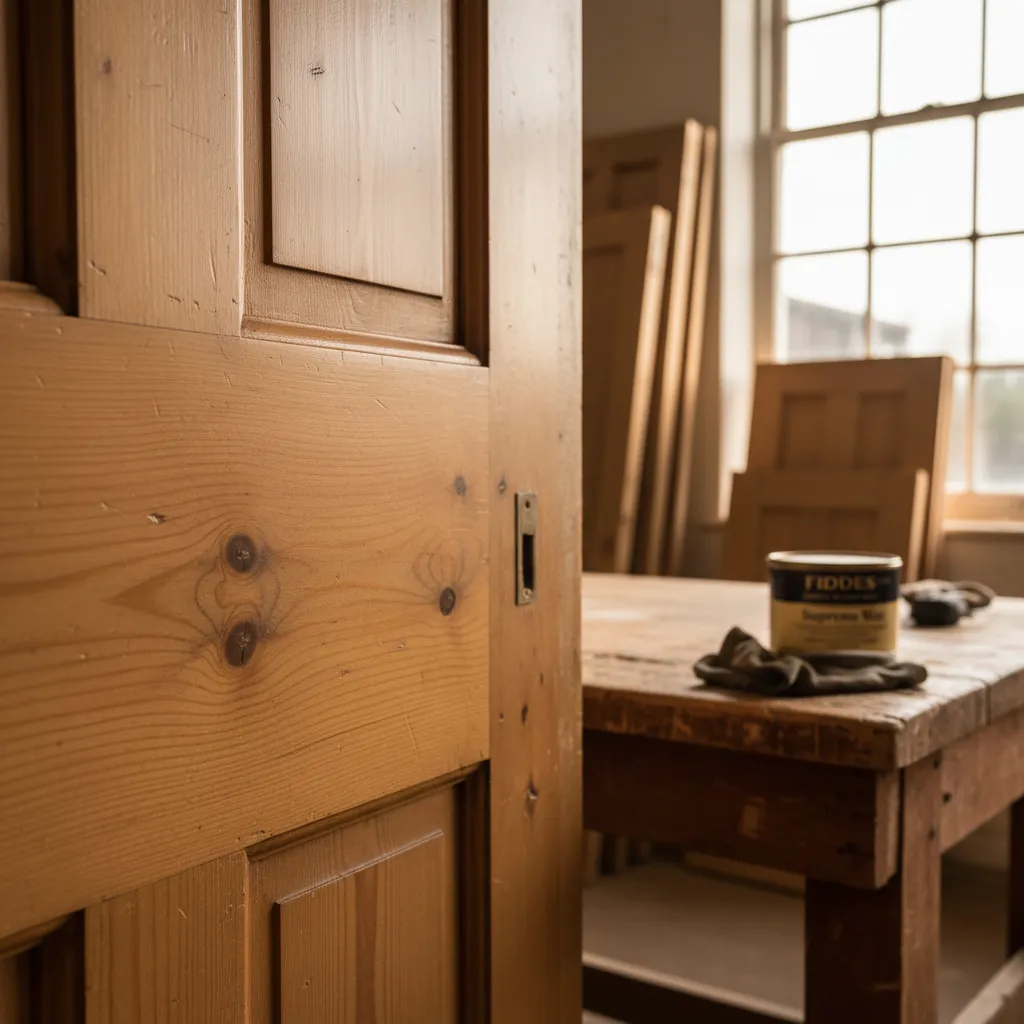
Choose wax when the grain is the point. Choose hard wax oil when you want more water resistance, for example in a kitchen or bathroom. Choose paint when the timber has too many repairs, stains or filled knots to look honest under a clear finish.
Can you paint reclaimed pine?
Yes, you can paint reclaimed pine, and it takes primer and topcoat well once fully dry and sanded. Pine is stable, accepts filler, and holds a primed edge on beading and mouldings better than most timbers.
Use a knotting solution on any resin pockets before priming, otherwise tannins bleed through pale colours within a season. Two coats of primer, light de-nibbing, then Farrow & Ball or Little Greene in your chosen sheen gives a finish that lasts 8 to 12 years on an internal door.
Can you wax pine doors?
Yes, you can wax pine doors, and wax is the traditional finish for Victorian and Edwardian pine throughout Yorkshire. Softwood drinks the first coat deeply, which is exactly what protects end grain around panels and the lipping on the stiles.
Apply three thin coats of Briwax, buff each one with a lint-free cloth or a soft brush on a drill, and leave 24 hours between coats. The first coat looks thirsty, the second starts to glow, the third sets the sheen.
Paint vs wax finish comparison
Paint covers, wax reveals. Paint costs more in prep and locks you into a colour for a decade; wax costs a tin and twenty minutes every six months. Paint chips at the handle and shows white lines; wax wears in and buffs out.
For a hallway or lounge door with light contact, wax wins on look and upkeep. For a bathroom, kitchen or utility door that takes steam and finger marks, a hard wax oil such as Osmo Polyx-Oil handles daily knocks far better than a soft wax alone.
Preparing stripped pine doors for finishing
Neutralise any door that has gone through caustic dip stripping before any finish goes on. A clear water rinse, then a wipe with white vinegar and water, then a full dry-out of 48 to 72 hours stops the alkali from ruining wax or oil.
If the door has been dipped recently, Daniel at the Honley workshop can check moisture content and confirm it is ready to finish. Skip this step and trapped alkali will ghost through wax, cloud hard wax oil, and stop paint from adhering.
Sanding grits and techniques for reclaimed pine
Work through 80, 120 and 180 grit, finishing at 180 for wax and 240 for paint or hard wax oil. Sand with the grain, ease each arris by hand, and vacuum or tack-cloth between grits so old finish does not clog the next paper.
Sand flat panels with a random orbital sander. Run folded sandpaper into mouldings and the corners of panels by hand, where a machine will round the edges. A light pass with a fine Scotch-Brite pad after final sanding gives wax something to grip.
How to strip painted pine doors
Bath-dipping in a caustic solution is the fastest method for painted pine doors, and it pulls old finishes out of the grain without the dust of sanding. After dipping, the door needs a thorough rinse and a neutralising soak, then two to three weeks of drying in a warm, ventilated space before any finish goes on. Hand-stripping with a heat gun works for delicate mouldings but adds hours per door.
Where reclaimed pine turns up in older homes
Stripped pine shows up well beyond doors. In the workshops that run through the same Yorkshire stripping baths, the same timber appears in antique furniture, in banisters cut from old floorboards, in bedsteads rescued from attic rooms, and in the softwood seating of church pews. Knowing where your door came from often tells you how it was milled, seasoned, and finished the first time round, which in turn shapes how it takes a second life.
You also see reclaimed pine fitted as panelling around cast iron fireplaces, where the contrast between warm softwood and cool iron is part of the look. The same rules apply: neutralise, dry, sand, then wax or paint to suit the timber in front of you.
Decision rule from the workshop
Use this three-question test on each door before choosing a finish: Is the timber sound, dry and free of large filled repairs? Will the door sit in a dry interior away from a shower or sink? Does the grain deserve to be seen?
Three yeses points to wax. A no on location points to hard wax oil. A no on timber condition points to paint.
Your next step for restoring reclaimed pine doors
Send a photo of each door, plus its rough width and height, to info@doubledipperpaintstrippers.co.uk or call 01484 666 333. Most Yorkshire and Greater Manchester jobs are quoted within a couple of working days, and collection from West Yorkshire can be arranged.
Bring up wet doors, newly dipped doors, and any door with a crack longer than 300 mm in the same message, so the quote can include drying time, repair work, and the correct finish from the start.
