Journal
Dip Stripping vs Hand Stripping: Which Suits Your Piece?
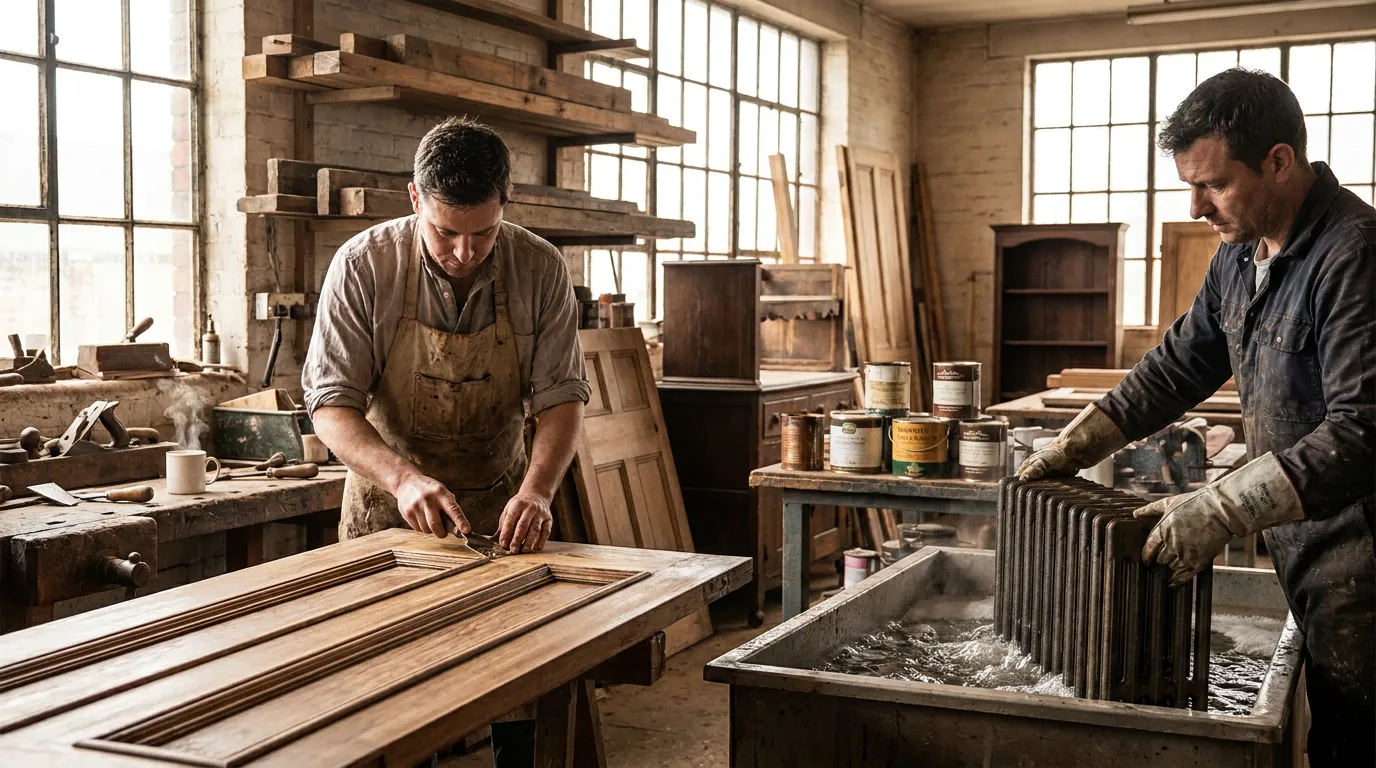
Dip Stripping vs Hand Stripping: Which Method Suits Your Piece?
A practical side-by-side from the Honley workshop covering dip stripping vs hand stripping for timber, cast iron fireplaces, wood doors and period furniture across West Yorkshire.
Dip stripping vs hand stripping comes down to what the piece is made of and how much risk you can carry. Dip stripping submerges a piece in a heated chemical bath so old paint lifts off in hours; hand stripping applies a controlled paste or solvent and scrapes it away by hand. For most heritage pieces in West Yorkshire, hand stripping wins on safety for veneer and old glue joints, while dip stripping beats it on speed and price for solid timber and cast iron fireplaces. As a Guild of Master Craftsmen member since 2016, Daniel Fitzpatrick personally handles every job from quote to finish, with direct communication and no middlemen. Paint stripping and restoration services, alongside heritage wood and metal restoration, all run from the same workshop in Crossley Mills, Honley, located in a Victorian textile mill.
The short version
If you want speed and a lower bill on a plain pine door or a cast-iron fireplace, dip stripping is the practical choice. If you own a Victorian four-panel door with original joints, a veneered sideboard, or anything with patina worth keeping, hand stripping is the safer method. Most period-property owners we speak to end up using both: dip for the bulky, sturdy items and hand for anything fragile or valuable.
When each method earns its keep
- Dip stripping suits solid timber doors, shutters, banisters, church pews, reclaimed scaffold boards, radiators, fire surrounds, gates and bedsteads. The bath reaches into carved mouldings no scraper can touch.
- Hand stripping suits veneered furniture, inlaid pieces, anything with glue joints, and items where the original surface matters as much as the paint on top.
At our Honley workshop, Daniel will only put a piece in the bath after seeing it in person. A few photos on WhatsApp get you a straight answer the same day on which route your piece needs. We also run hand and bath paint stripping for wood doors, fireplaces and metalwork from the same Victorian textile mill building in Honley, and link to our sister workshops for kitchens and wood turning where a project calls for it.
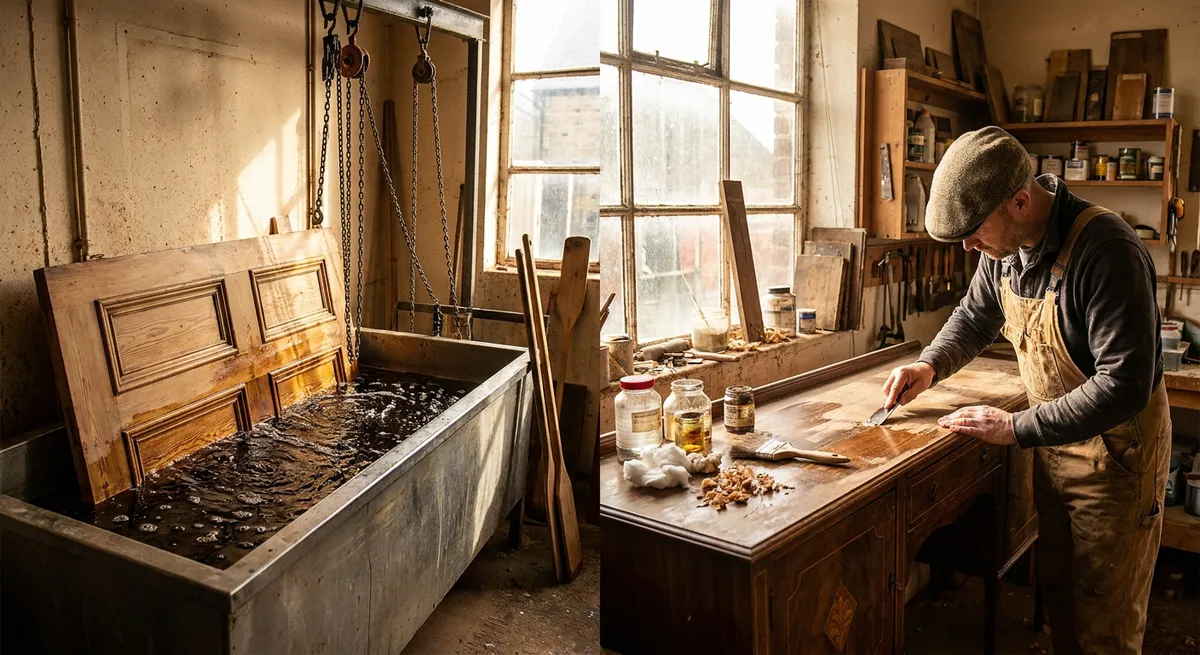
Compare our dip and hand stripping services or send a photo to get a fixed quote.
Caustic Baths, Gentle Hands and the Pieces Each One Ruins
Caustic vs non-caustic stripping process
Caustic baths use a heated sodium hydroxide solution to break down old paint and varnish, and they remain the workhorse of commercial dip stripping because they reach into moulding no scraper can touch. Non-caustic alternatives, including methylene chloride pastes, soy-based gels and newer alkaline-free formulas, work more slowly but carry a lower burn risk on timber and are kinder to antique glue lines. At the Honley workshop we use caustic baths for solid timber and cast iron fireplaces, and reserve non-caustic pastes for any piece showing veneer, marquetry or signs of older hide glue. Double Dipper Paint Strippers, alongside most established commercial dippers, run similar heated caustic baths, so the same logic applies across every setup we have seen.
Which woods and metals survive a dip tank
Solid hardwoods handle bath stripping well. Oak, pine, beech, mahogany and reclaimed structural timber come out clean, with carved details intact and no gouging. The bath reaches into mouldings a scraper cannot, which is why we dip most Victorian four-panel doors, church pews and cast-iron fireplaces at the Honley workshop.
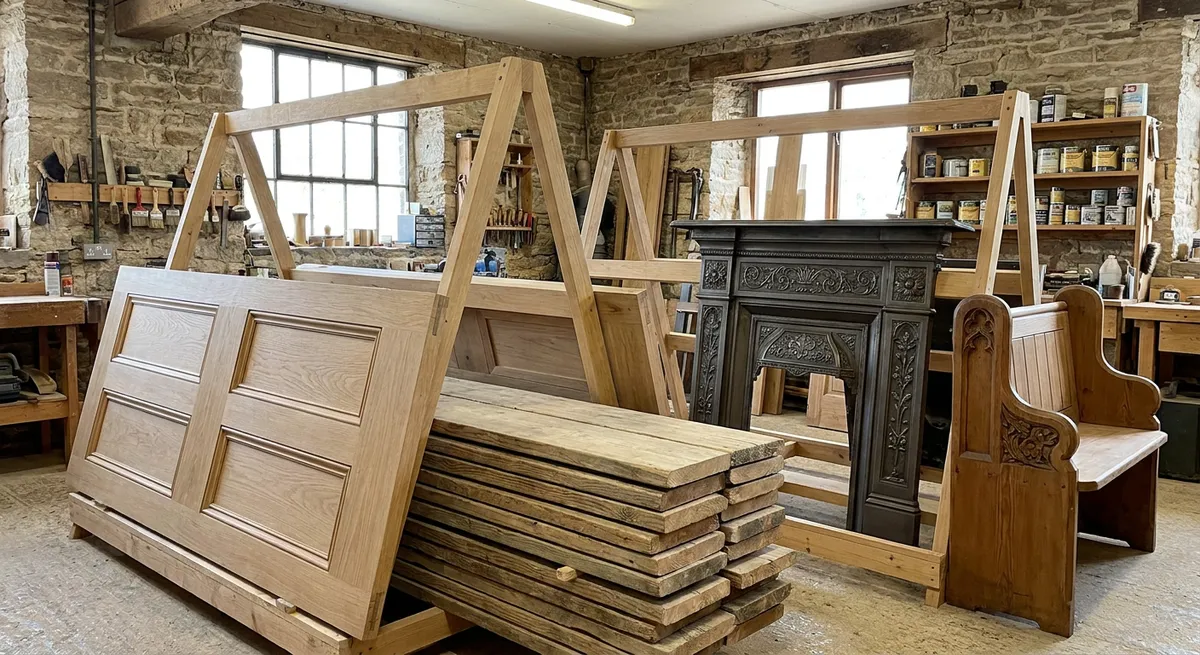
Cast iron is the stand-out success. A bath strips forty years of cracked gloss off a fireplace in under two hours, something hand scraping cannot match. Brass and steel behave similarly, provided rust treatment follows within 24 hours.
The rule we use in the workshop: if the piece is solid, free of modern acrylic paint and free of glue lines, the tank is usually the faster, cheaper choice. Double Dipper Paint Strippers run similar heated caustic baths commercially, and the same logic applies across every dip-stripping setup we have seen.
Limitations of dip stripping on veneer, plywood and old glues
The same bath that rescues a solid oak door will wreck a walnut sideboard. Three materials fail on contact: plywood, MDF and particle board swell and delaminate as the old glue softens. Veneer lifts at the edges, sometimes invisibly, before anyone spots the damage. The risk is even higher on antique furniture where a single ruined face hides a century of patina.
Pre-1950 furniture is a gamble. Animal glues and old hide bonds break down in a caustic bath, and joints that have held for a century simply let go. We lost a marquetry writing slope to a subcontracted dipper back in 2018; we have not sent a veneered piece to a tank since. Outside outfits such as Double Dipper Paint Strippers will still happily dip a sent-in item, so the responsibility for spotting veneer before it goes in sits firmly with the owner.
For any veneered, plywood or antique-glued item, hand stripping with a controlled paste stripper is the only safe route. It takes longer and costs more, but the piece survives intact. Send a photo before booking and we will tell you straight which method fits.
Cost, Time and the Honest Trade-Offs Between the Two
How the two methods compare in price and turnaround
Dip stripping a standard Victorian four-panel door at our Honley workshop starts at around £85, with most jobs back inside two to three weeks. Hand stripping the same door runs £140 to £220 depending on moulding depth and condition, and adds a week or two for slower, more careful work. A cast-iron fireplace tells the same story in reverse: a bath removes decades of thick gloss in a single morning for roughly £60 to £90, while hand scraping the same piece can swallow six hours and double the cost.
Time on site tells a similar tale. A dip-and-return job needs you for nothing; a hand-stripped piece stays in the workshop longer and may need a second visit for finish coats. If you are restoring several pieces at once, mixing methods is often the smartest route: dip the doors and radiators, hand-strip the sideboard and the fretwork.
Is hand stripping painful for a dog?
No. Hand stripping a dog is a painless grooming technique that removes only the dead, loose topcoat, not the live hair underneath, so most wire-haired dogs tolerate it well. Many owners notice their terrier seems calmer after a session compared with clippers, which can snag and pull.
What is the most effective way to strip paint?
The most effective paint-stripping method depends on the piece: a controlled chemical dip removes decades of build-up from ornate doors in hours, while patient hand stripping with a quality paste preserves the patina on a 19th-century sideboard. Match the method to the timber, the age and the joinery — speed matters less than keeping the wood intact.
What breeds benefit from hand stripping?
Wire and harsh-coated breeds benefit most from hand stripping because it keeps the coat's wiry texture and rich colour. Think Jack Russell, Border, Fox, Welsh and Lakeland Terriers, Airedales, Schnauzers, German Hunt Terriers and Griffons, plus show Cocker and Irish Setters whose coats demand traditional rolling.
What is a dip strip?
A dip strip is a bath-stripping process where a piece is fully immersed in a heated chemical tank so old paint and varnish lift off the surface. Once neutralised, the item is rinsed, dried and oiled within hours to stop the timber from drying out.
The honest trade-offs
Across both furniture restoration and dog grooming, the same rule applies: choose the gentler option when value, age or sensitivity is high, and choose the faster option when the item is replaceable. Dip stripping vs hand stripping is rarely an either/or question in a period property; dip stripping wins on speed and price, while hand stripping wins on control, veneer safety and finish preservation.
Getting Your Piece to the Workshop in Honley
When to book the dip stripping and restoration service
Book when the piece is solid, free from veneer and built to take a chemical bath — Victorian pine doors, church pews, cast-iron fireplaces and reclaimed timber all fit. Allow four to six weeks for the full cycle during busy periods. Spring and early autumn are the sweet spots: lighter demand, and Yorkshire humidity sits in a workable range so timber dries evenly after its dip.
A short checklist before you get in touch saves a wasted trip:
- Solid timber or cast iron (no plywood, MDF, or thin veneer)
- All ironmongery removed or marked for removal on site
- Any glued joints sound; wobbly tenons need a joinery fix first
- Item dry, not recently oiled, and free of wax polish in the cracks
- Clear photos of the front, back and any carved detail
Send photos and a postcode for a same-week quote
Daniel quotes every job himself. Send three or four sharp photos (one straight-on, one of any carved or moulded detail, one of any damage) plus your postcode, and he will reply with a price and a turnaround window, usually within a working day.
Collection across West Yorkshire and Greater Manchester runs on set days, with delivery back on the same run where the route allows. Further afield, a courier quote can be arranged. Daniel is the only point of contact from quote to finish, with direct communication and no middlemen, so any question about finish, timing or pick-up goes straight to the man with the scraper in his hand. Paint stripping and restoration services are quoted the same way, with one price and one name on the job from start to finish.
Sources
- Don't Let A Refinishing Company Dip Strip Your Furniture | Jax Furniture Refinishing & Upholstering
- Hand or Dip Stripper? - Forum Archive
- Dip Stripping Furniture | Jax Furniture Refinishing & Upholstering
- Dip & Strip - FineWoodworking
- Dip and Strip 101: Everything You Wanted to Know About Stripping Wood and Metal
- Dip stripping doors and furniture and what to consider
- Dip & Strip Paint Removal | JG Nasile Painting
- How to Strip Furniture the Right Way - Every Time!
