Journal
Stripping a Victorian Front Door Without Damaging the Wood
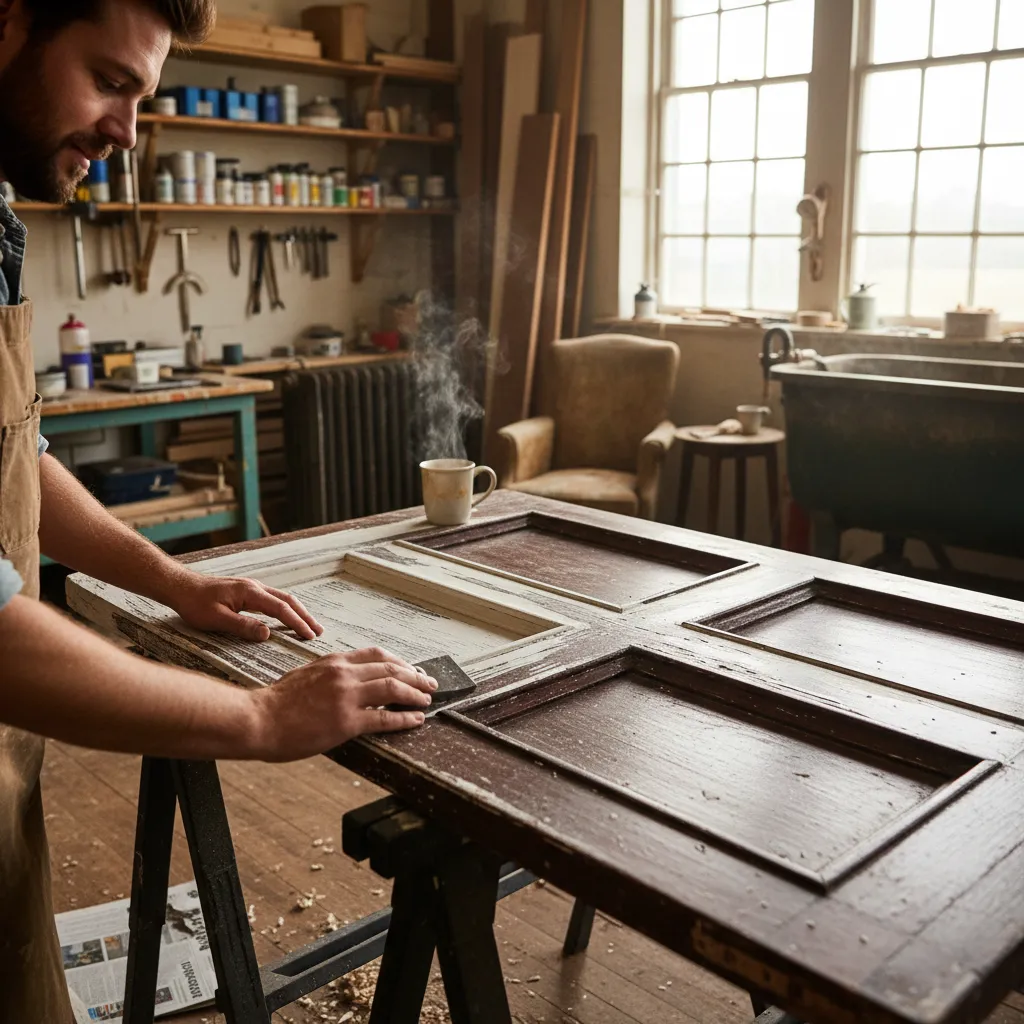
Quick answer: stripping a Victorian front door without damaging the wood
Stripping a Victorian front door without damaging the wood comes down to chemistry and hand tools, not heat or spinning discs.
Lay the door flat, use a gel or paste stripper with enough dwell time, then finish with plastic scrapers and bronze wool. Heat guns, belt sanders and steel blades cause most of the harm you see on old doors.
In our Honley workshop, the doors that arrive in the worst condition are almost always the ones a previous owner attacked with a belt sander or blowtorch. A softer method gets the paint off and keeps the grain, panels and corner quirks intact for refinishing with Osmo, Fiddes wax, or a coat of Farrow & Ball or Little Greene.
Will stripping damage the wood?
Done well, stripping paint from a Victorian front door does not mark the timber. The damage comes from the method, not from the act of stripping.
Heat guns and blowtorches scorch soft pine and lift grain on cedar within seconds. Random-orbit sanders round off the crisp arrises on panels and mouldings. Aggressive metal scrapers leave gouge marks that filler only highlights. Each of those mistakes is permanent and shows up the moment a clear finish goes on.
The safer route is chemical or infrared work plus hand finishing. The same principle applies to antique furniture, banisters, church pews and reclaimed timber that arrives from restorers across West Yorkshire: gentle methods, patient dwell times, sharp hand tools.
How to strip paint off wood without damaging it
Use a gel or paste stripper that clings to vertical surfaces, give it the dwell time on the tin, then lift the softened paint with plastic scrapers and bronze wool. No heat, no spinning discs, no force.
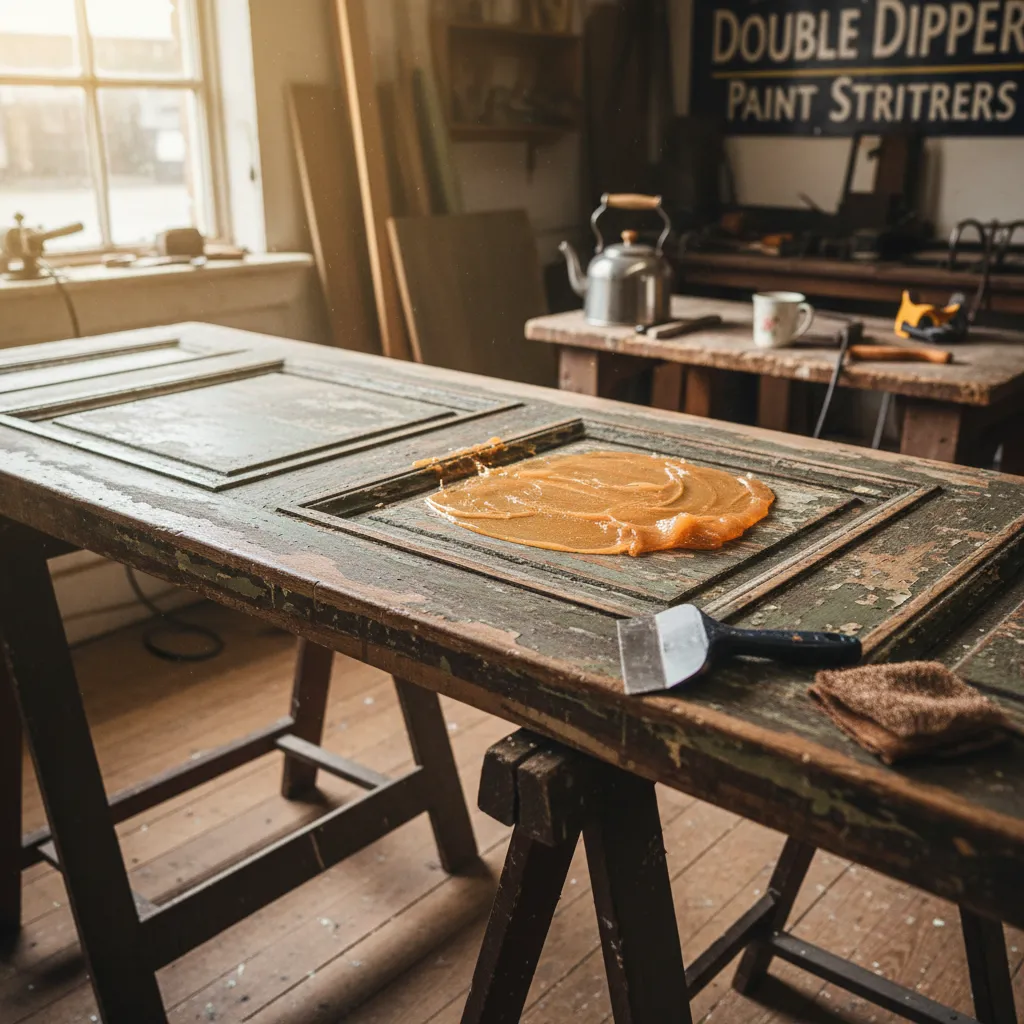
Citristrip works on most household layers in around 30 minutes. Peel Away 7 suits heavier build-ups and ornate profiles, though it needs roughly two days covered with its paper backing to stay damp. For delicate carvings, glazed panels and lead-painted doors, infrared heaters soften the paint without burning the timber, which is why we use them on the trickiest jobs that come through the workshop door.
Whatever stripper you choose, neutralise the residue (mineral spirits for most pastes, water for caustic types) before any sanding begins. Skipping that step locks old chemistry into the grain and clouds the new finish.
How to strip paint from an old front door
Take the door off its hinges, lay it flat across a pair of trestles in a ventilated space, and work from the top panel down. Flat work lets the stripper dwell and stops runs from softening layers you have not reached yet.
Remove the knocker, letterbox, escutcheons and hinges first and label each fixing point so nothing goes missing. Mask the glass with tape and newspaper. Apply stripper to one section at a time rather than the whole face, so it stays active where you are still scraping. Detail tools, dental picks, shave hooks and contour scrapers, get into the corners a flat blade cannot reach, especially around the beading on a four-panel door.
If the door is pre-1970s, treat the paint as lead-based and wear a respirator with P3 filters, not a paper dust mask. Under the Control of Lead at Work Regulations 2002, any work likely to disturb lead paint on a structure older than 1970 should be planned, contained and cleaned by someone trained for the job.
Spotting lead paint on a pre-1970s door
Lead-based paints were banned for domestic use in the UK in 1978, so any Victorian or Edwardian door almost certainly carries lead under the topcoats. A basic lead-in-paint test kit from a hardware supplier gives a pink or red result in seconds when rubbed on the coating. Treat every door built before 1970 as lead-positive until a kit proves otherwise. Lay dust sheets, work wet, and bag waste separately for disposal. The HSE lead pages spell out the legal duties for anyone tackling more than a small DIY patch, and they cover the COSHH angle for anyone working a door for paying customers.
Chemical strippers suitable for wood
Gel and paste strippers are the safest choice for timber because they lift the paint through chemistry, not friction. Citristrip clings to vertical surfaces for around half an hour and shifts several layers at once. Peel Away 7 stays damp under its paper for roughly two days and pulls paint out of deep mouldings in sheets. Methylene chloride (DCM) strippers work faster, but the HSE tightened the rules on DCM in 2012 over acute toxicity, so most home workshops, including ours, avoid them. For metal pieces, cast-iron fireplaces, radiators, bedsteads and gates, the same gel approach cuts through old gloss without attacking the iron underneath, and it can be paired with a rust treatment once the paint is gone.
Peel Away and paste techniques on mouldings
Trowel the paste on thickly, press the supplied paper into it, and leave the door flat for 48 hours. Lifting the paper pulls paint out of quirks and beadwork in a single sheet, which is why we reach for Peel Away 7 on the four-panel and glazed front doors arriving from Huddersfield, Halifax and the surrounding villages. Finish with a bronze contour scraper and a dental pick rather than a steel chisel; Daniel keeps a set of Nela and Bahco detail tools in the workshop because a steel blade slips on a quirk bead and leaves a dig filler cannot hide.
Neutralise any residue with mineral spirits, let the wood dry for a week in the workshop, then decide whether to seal with Osmo hardwax oil, wax from Fiddes, or repaint in Little Greene or Farrow & Ball. If you want a bare-wood look, raise the grain with a damp cloth and de-nib with a fine pad before the first coat of oil.
Next steps: from DIY to a Yorkshire workshop that handles every job
When a door paint stripping service is the better choice
Hand work pays off on a single panel, but a full Victorian front door sits at a different scale. Most doors Daniel sees in the workshop arrive with eight to twelve layered paint coats, moulded beads, and corner quirks that punish shortcuts. Stripping a Victorian front door without damaging the wood at that scale usually needs a controlled chemical bath that gets behind the beading where scrapers cannot reach, plus a dust-free space for the neutralise and dry stages.
Call in a specialist when the door carries lead paint, intricate carvings, or rot around the joints. A bath dip lifts the colour without scorching the grain or burning through any original varnish underneath, and it strips matching door frames at the same time. The same workshop handles matching pieces, so a front door, its frame and a set of banisters can come back with the same patina and finish.
DIY makes sense for a flat interior panel and a weekend to spare. It rarely makes sense for a 120-year-old front door with original glass and brass furniture, where one slip with a scraper or heat gun costs more than the job itself. Stripping a Victorian front door without damaging the wood is also the wrong place to cut costs; a full strip and refinish typically runs £180 to £320 for a single door, and redoing a botched DIY job lands at two to three times that.
Get a quote from Double Dipper Paint Strippers
Double Dipper is a one-craftsman workshop in Crossley Mills, Honley, run by Daniel Fitzpatrick, a Guild of Master Craftsmen member since 2016. Every door is quoted, stripped, and finished by Daniel personally, no middlemen, no subcontractors. The kettle is on most days if you would rather talk it through in person.
The workshop offers free pick-up and delivery across West Yorkshire and Greater Manchester, so a heavy front door does not need to travel on a roof rack.
Send a phone photo, the door's width and height, and your postcode to info@doubledipperpaintstrippers.co.uk, or ring 01484 666 333 for a same-week quote.
Sources
- Eight handy pointers for refreshing the entrance door of a period Victorian property
- Five Tried-and-True Methods for Stripping and Refinishing Wooden Doors (Pro Advice)
- Safely Removing Paint from Period Wooden Sashes and Doors, Austin Historical
- Removing Old Paint from Doors, House of Brinson
- Stripping Paint from Victorian Doors While Keeping Their Charm Intact, YouTube
- Lead and You, Health and Safety Executive
- Regulating Dichloromethane in the Workplace, Health and Safety Executive
